
Service
Electrical work in Dénia, Jávea and surroundings
We renew complete electrical installations in flats, apartments and houses: from stripping out the old wiring to handing over a new consumer unit with every circuit labelled. We almost always do it as part of a renovation, making use of chases, suspended ceilings and open walls so the cabling ends up concealed and accessible.
If your installation is more than 25 or 30 years old, the RCD trips when you switch on the oven, or you are about to add air conditioning or an aerothermal heat pump, it is time to have it done new and properly sized. Where certification is required, we work with an authorised installer.
What does this service include?
Stripping out the old installation
We remove aluminium or undersized cable, deteriorated boxes and fuse boards. We never leave old runs spliced onto new ones.
New consumer unit
Board with main switch, RCDs by zone and an MCB for each circuit, every line labelled so you know what switches off what.
Circuits and cable sizing
Independent circuits for kitchen, oven, washing machine, air conditioning, heat pump and water heater. Each with the cable size and protection it calls for.
Chasing or cabling via the ceiling
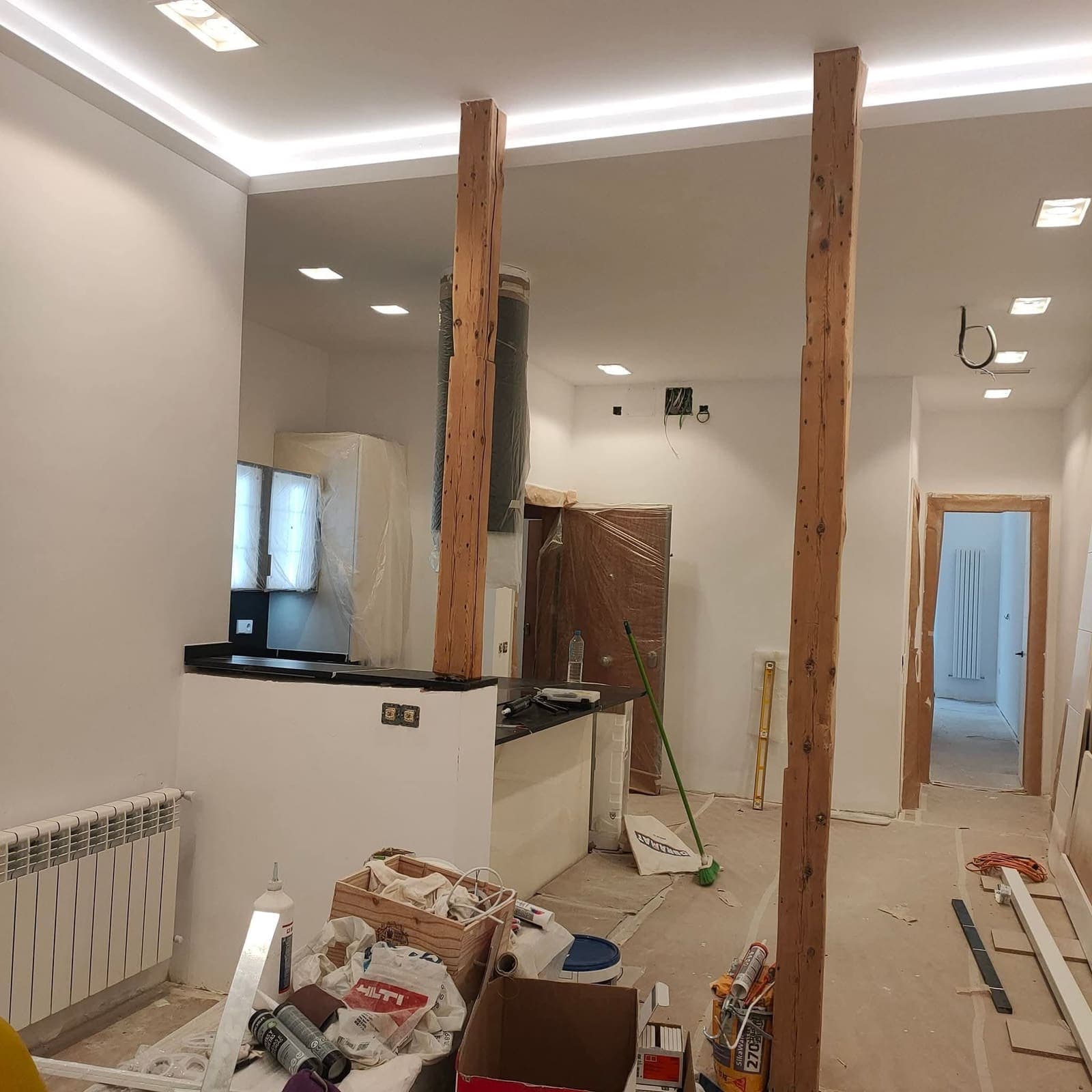
In brick walls we cut chases and run flexible conduit. Where there is a plasterboard ceiling, the cabling runs above it and drops down only where needed.
New lighting points and sockets
We plan with you where you will genuinely need sockets: bedheads, kitchen island, home-office area, terrace, USB outlets if you want them.
LED lighting
Downlights, LED strips in wardrobes and suspended ceilings, dimmable light in bathrooms and living room, mirrors with built-in lighting. We choose the colour temperature room by room.
Switches, sockets and finishes
Fittings from the range you choose, level and at the same height throughout the house. Plates, frames and trims with no rough plaster around them.
Testing and certification
We test every circuit and the response of the protective devices before closing up. If your supplier or the council requires paperwork, we coordinate with an authorised installer.
Jobs we do regularly
Complete new installation
Replacement of the entire installation as part of a full renovation: consumer unit, circuits, points and fittings.
Supply upgrade and new consumer unit
New board and dedicated circuits for an induction hob, oven, air conditioning or aerothermal heat pump.
Bathroom and kitchen electrics
New points, lighting and protection in the two rooms with the highest load and the most moisture.
LED and integrated lighting
Suspended ceilings with indirect light, strips in wardrobes, and dimming of brightness and colour tone.
How we rewire a home
We start with a simple schematic: which circuits the home needs and what load will hang off each one. Kitchen, oven, washing machine and dishwasher do not share a circuit with the living-room sockets; the air conditioning and the heat pump get their own. With that clear, we size the consumer unit and the cable for each run, and not the other way round.
Then comes the strip-out. We remove the old installation completely, including what is sometimes left hidden in suspended ceilings and behind skirting boards. An old cable spliced onto a new one is a point of failure that shows up two years later, so we do not do it.
The routing depends on the renovation. In brick walls we cut chases with a wall chaser and dust extraction, fit flexible conduit and junction boxes, and make good with plaster or tile adhesive depending on the substrate. When the home has a plasterboard ceiling, the main cabling runs above it in conduit and only the drops come down to each fitting. That means fewer chases, less dust and easier extension in the future.
Switches and sockets go in at the end, once the painting is done, all at the same height and plumb. Before closing the board we check continuity and earth on every circuit and test that every RCD and MCB trips where it should.
Materials and solutions we recommend
- Copper cable sized for each use: 1.5 mm² for lighting, 2.5 mm² for sockets, 6 mm² for the hob and oven, and independent circuits for air conditioning and the heat pump. Oversizing does no harm; undersizing makes the cable run hot.
- A consumer unit with spare space. A board filled to the brim has to be redone when the EV charger or a second air-conditioning unit comes along. We leave spare modules.
- RCDs by zone instead of a single one: if the bathroom trips, the fridge does not go dark.
- LED lighting with the tone chosen for each room: warm in bedrooms and living room, neutral in the kitchen and work areas, dimmable in bathrooms. In the bathroom renovation in Gandía the mirror switches between warm and cool light with a touch, and it is one of the things the client appreciates most.
- Surge protection in the board where the area suffers from power cuts or storms, common in urbanisations around Jávea and Dénia with overhead lines.
If the budget is tight, we prioritise what you cannot see: consumer unit, cabling and circuits. Switches, sockets and light fittings can be upgraded later without opening anything up.
Common mistakes we avoid
- Reusing deteriorated boxes and conduit to save on chasing. A crushed conduit or one full of plaster will not take new cable and ends up as a botch job with surface-mounted wiring.
- A single circuit for the whole kitchen. Oven, induction hob and dishwasher together trip the protection or, worse, the protection holds and the cable heats up.
- Forgetting the earth in older flats where there never was one. Without an earth, the RCD does not protect the way it should.
- Sockets where they were, not where they are needed. With the wall open it costs the same to put them in the right place: bedheads, island, work area, terrace.
- Closing up without testing. Every circuit is checked before it is covered; finding a fault once the wall is painted costs three times as much.
Indicative timescales
- Extending a consumer unit with two or three new circuits: 1 or 2 days.
- Bathroom or kitchen electrics as part of their renovation: 2 or 3 days split between the chasing phase and the finishing phase.
- Full installation for an 80 to 100 m² flat during a complete renovation: between 5 and 8 days of actual work, interleaved with building work and plasterboard.
- Two-storey house or villa: from two weeks, depending on floor area and number of circuits.
Timings are coordinated with the other trades. What we do not do is close up walls with the electrics half finished to gain a day.
Electrical work for homes in Dénia, Jávea and Gandía
Many 1970s and 80s flats in Dénia and Gandía still have 3 kW installations designed for a washing machine and a television. Today they are living alongside an induction hob, ducted air conditioning and an electric water heater, and the result is a board that trips every summer. Renewing the installation as part of a renovation solves the problem at the root and avoids emergency patch-ups.
In holiday apartments near the beach, the salt air corrodes terminals, sockets and outdoor boxes. We recommend fittings with good contacts, weatherproof boxes on terraces and checking the board when the property has been closed up for months.
In villas around Jávea, Moraira or Benissa it is common to have to feed a heat-pump unit on the roof, irrigation pumps and a guest house from a single board. There, it matters to calculate voltage drop on long runs and choose the cable size accordingly.
If you live abroad and the renovation goes ahead without you, we send you photos of the chases and the consumer unit before anything is covered, so you can see where everything sits. Whenever you want to talk about your installation, write to us and we will arrange a no-obligation visit.
How we work
Visit
We visit your home with no obligation, take measurements and listen to what you need.
Itemised quote
Line by line and in writing. A small job is priced quickly; a complex one may take a few days.
The work
Yuriy coordinates the trades and is on site. Any changes are priced before they are made.
Handover
We go over the work with you, clean up and hand it over ready to use.
Frequently asked questions about electrical work
How do I know whether I need a full rewire or just part of it?
If the cables are aluminium, there is no earth, the board has fuses or a single RCD for the whole house, the sensible thing is a complete rewire. If the installation dates from the 1990s or later and you only want to add air conditioning or an induction hob, extending the consumer unit and running new circuits is usually enough. We look at it on the site visit and tell you plainly what is worth doing.
Do all the walls have to be opened up to change the cables?
Not always. If the renovation includes a plasterboard ceiling, most of the cabling runs above it and only the drops to switches and sockets need opening. In walls that are not being touched, the existing conduit can sometimes be reused to pull new cable through, provided it is in good condition and has no impossible bends.
Does KAS issue the electrical installation certificate (CIE)?
The installation certificate is signed by an authorised installer. We carry out the installation in line with the regulations and, when the paperwork is needed (supply upgrade, change of account holder with an old installation, certification after a renovation), we coordinate with an authorised installer we work with regularly so they can issue it.
How long does it take to rewire a flat?
In an 80 to 100 m² flat as part of a renovation, the cabling and boxes take around 4 to 6 working days, spread out as the building work progresses. The consumer unit, fittings and light fixtures go in at the end, in 1 or 2 days. If it is the installation alone with no renovation, add the making good of chases and painting.
Can the installation be left ready for a heat pump or an EV charger even if I am not installing it now?
Yes, and it is the most practical approach. We leave the circuit with its protection in the board and the conduit run to where the equipment will go, capped off with a box. When you decide to install it, nothing has to be opened up again.
What supply capacity should I contract after the renovation?
It depends on what you will have running at the same time: induction hob, oven, air conditioning and heat pump add up quickly. We calculate the load with the new installation and tell you what to contract; you request the change from the distributor yourself, with the authorised installer's paperwork if they ask for it.
Electrical work near you
We work in Dénia, Jávea and surroundings: Dénia, Jávea / Xàbia, Gandía, Ondara, Oliva, Pego, Benissa, Moraira, Calpe and the surrounding area.
Shall we talk about your renovation in Dénia, Jávea and surroundings?
Tell us what you need in terms of electrical work. Free visit and quote, no obligation.