
Service
Aerothermal heat pumps and underfloor heating in Dénia, Jávea and surroundings
We install aerothermal heat-pump systems with wet underfloor heating in new homes and complete renovations, and electric underfloor heating beneath porcelain tiles in renovations of one or several rooms. One installation for heating, cooling in summer and hot water, with no radiators on the walls and no equipment on show.
We do the part we control ourselves: insulation panel, circuits, manifolds, hydraulic connections, outdoor units, hot-water cylinder and coordination with the screed and the flooring. Where the installation calls for an authorised refrigeration or gas installer, we work with one.
What does this service include?
Survey of the property
Floor area, orientation, insulation and how each room is used. That decides the output of the unit, the number of circuits and whether underfloor heating is the best option or should be combined with something else.
Outdoor units and hot-water cylinder
Siting of the outdoor unit on the roof, terrace or patio on a plinth, insulated lines into the house and a hot-water cylinder with its valves.
Insulation panel and circuits
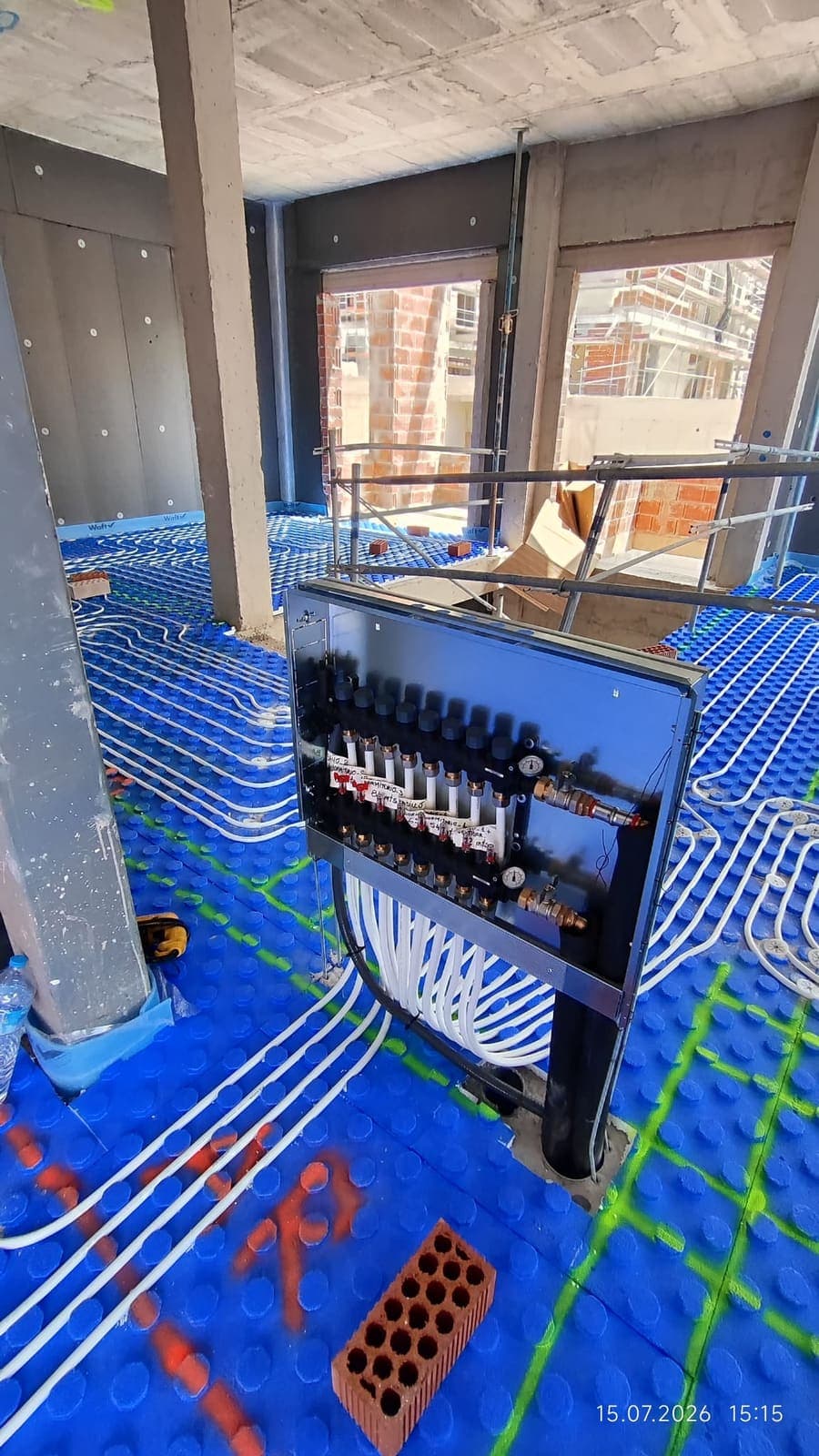
Castellated panel that insulates from the slab and holds the pipe, and multilayer circuits laid in a spiral, one per room, so each room can be controlled separately.
Manifolds
Manifold with flow meters to balance the circuits, positioned somewhere accessible and serviceable.
Electric underfloor heating
Heating mat or cable beneath porcelain tiles in bathrooms, kitchens or whole flats during a partial renovation, covered with self-levelling compound.
Hydraulic and electrical connections
Primary circuit, pumps, expansion vessel and a dedicated electrical supply from the consumer unit with its own protection.
Testing and commissioning
Circuits pressurised before the screed goes down and the system started up with the manufacturer's commissioning where the warranty requires it.
Coordination with screed and flooring
We leave the installation ready for the screed and check that the flooring you have chosen is compatible with radiant heat.
Jobs we do regularly
Heat pump with wet underfloor heating
New build or complete renovation: the full system, from the outdoor unit to the last circuit.
Electric underfloor heating in a renovation
Beneath the new porcelain tiles in a bathroom, a kitchen or the whole home, without raising the floor much.
Heat pump for hot water
Replacing the electric water heater with an aerothermal hot-water cylinder, with lower consumption and more capacity.
Underfloor cooling in summer
Cooling through the floor with humidity control, or combined with fan coils in the warmest rooms.
How we install a heat pump with underfloor heating
In a new build or a complete renovation, wet underfloor heating goes in before the screed, and that is the moment it comes out right. On the clean slab we lay the castellated insulation panel, which thermally separates the system from the floor and holds the pipe without clips. Before laying anything, we set out the partition walls and service runs on the panel and mark the route of each circuit so they never cross stacks or inspection chambers.
The circuits are laid in a spiral of multilayer pipe, one per room, all running to the manifold with flow meters, which lets us balance the flow so the furthest room heats just as well as the nearest one. That is how it was done in the newly built house in a rural part of Benidorm: panel across the whole floor, one circuit per room, manifold and equipment, and the installation was left pressurised and tested, ready for the builder to lay the screed on top.
On the roof or terrace we mount the outdoor units on a plinth, with the lines insulated into the house, and in a plant room the hot-water cylinder with its valves and connections. The electrical supply comes on a dedicated circuit from the consumer unit.
When the renovation is partial or there is no depth for a screed, the answer is electric underfloor heating: heating mat or cable over the levelled substrate, a temperature probe, and a layer of self-levelling compound that protects it and leaves a flat base for the porcelain tiles. In the complete renovation with soundproofing in Dénia we fitted it throughout the whole flat with this system, with no steps between rooms.
Materials and solutions we recommend
- Castellated panel rather than flat panel with clips: it holds the pipe better and protects the insulation during the works.
- Multilayer pipe with an oxygen barrier for the circuits, which holds its shape and does not get crushed when the screed is poured.
- Manifold with flow meters and thermoelectric actuators on each circuit, so every room can be controlled by its own thermostat.
- A hot-water cylinder sized for real use: two bathrooms showering at the same time cannot be served by a small tank.
- Connected thermostat in holiday homes, so you arrive to a house already at temperature.
- Electric underfloor heating in bathrooms and individual rooms during a partial renovation, or in flats where the floor cannot be raised.
- Porcelain tiles as the flooring over the heating, and wood only if it is certified for it.
If the budget does not stretch to everything, a reasonable option is to install the underfloor heating and the aerothermal hot-water cylinder now, and leave the connection for the heating unit ready for later. No exaggerated figures: what is worth doing, we work out with your real consumption.
Common mistakes we avoid
- One circuit that is too long in order to cover two rooms: the water arrives cold at the end and there is no way to balance it.
- Pouring the screed without the installation pressurised: if something leaks, it gets discovered with the floor already down.
- Outdoor unit in a corner with no airflow or drain: performance drops and the condensate ends up on the neighbour's wall.
- Electric underfloor heating without self-levelling compound or with the probe badly placed: some tiles heat more than others and the thermostat cannot regulate.
- Uncertified wooden flooring: it opens up at the joints in the first winter.
Indicative timescales
- Wet underfloor heating on a 100 to 150 m² floor: between 3 and 5 days for panel, circuits and manifold, plus 1 or 2 for equipment and connections. After that, the screed needs its drying time before the flooring goes down.
- Electric underfloor heating in a bathroom: half a day for the mat and self-levelling compound, within the bathroom renovation.
- Electric underfloor heating in a whole flat: 2 or 3 days of installation before the flooring.
- Replacing a water heater with an aerothermal cylinder: 1 or 2 days.
The quote for a complete installation takes a few days to work out: output, number of circuits, equipment and availability. We would rather get it right than give you a figure that changes later.
Heat pumps and underfloor heating for homes in Dénia, Jávea and Gandía
The coastal climate is the heat pump's best ally: mild winters in which it performs very efficiently, and summers in which the same unit can cool. What is less well known is how well it works in a 1980s flat in Dénia or Gandía with an electric water heater and oil-filled radiators: replacing both with a heat pump and electric underfloor heating beneath the new porcelain tiles transforms both the bill and the comfort, without raising the floor.
In villas around Jávea, Moraira or inland towards Pego, with large and often poorly insulated houses, wet underfloor heating with a heat pump is the most balanced system, and the outdoor unit usually fits on the roof or in a service yard. There, it is worth reviewing insulation and windows as part of the same renovation, because heating a house that loses heat through its windows costs the same with any system.
In holiday homes used seasonally, phone control and a good hot-water cylinder mean you arrive to a warm house and hot water for everyone. If you are not at the property during the installation, we send you photos of the circuits and the manifold before the screed and of the system start-up. Tell us which property you want to heat and cool and we will study the best solution on plan and on the site visit.
How we work
Visit
We visit your home with no obligation, take measurements and listen to what you need.
Itemised quote
Line by line and in writing. A small job is priced quickly; a complex one may take a few days.
The work
Yuriy coordinates the trades and is on site. Any changes are priced before they are made.
Handover
We go over the work with you, clean up and hand it over ready to use.
Aerothermal heat pumps and underfloor heating projects
Frequently asked questions about aerothermal heat pumps and underfloor heating
What exactly is an aerothermal heat pump?
It is a heat pump that extracts energy from the outside air and transfers it to the water in the heating system and the hot-water cylinder. For every kilowatt of electricity it uses, it delivers several kilowatts of heat, and in summer it can reverse the cycle to cool. On the Alicante and Valencia coast, with mild winters, it performs at its very best.
Can underfloor heating be fitted in an existing flat?
A wet system, only if the renovation is a complete one and the whole floor is being lifted, because it needs panel, pipe and screed, around 6 to 8 cm in total. If the renovation is partial or there is no depth available, the option is electric underfloor heating: a mat beneath the porcelain tiles with self-levelling compound, which adds barely 1 or 2 cm. That is how we did it in the complete renovation in Dénia, throughout the whole flat.
How much does it save compared with gas or electric radiators?
It depends on how well the home is insulated, how you use it and the price of energy at any given time, so be wary of round figures. What is constant is that a heat pump uses considerably less electricity than a radiator or an electric water heater to deliver the same heat, and that underfloor heating runs at a low temperature, which is where a heat pump performs best. On the site visit we make an estimate using your real consumption.
Where does the outdoor unit go?
On the roof, on a terrace or in a patio, on a plinth with anti-vibration mounts, with the lines insulated into the house. It needs air around it and a drain for the condensate. In apartment buildings it is worth checking the community rules first; we help you work out where it can go.
What flooring can I lay over underfloor heating?
Porcelain and ceramic tiles conduct heat best. Wood and laminate are fine if the manufacturer certifies them for underfloor heating and the thickness is respected. Carpets and some thick vinyls hold the heat back. We confirm it with you before you buy the flooring.
Do I need an authorised installer?
For the refrigerant side of some units and for gas, if there is a back-up boiler, the regulations require an authorised installer, and we work with one. We carry out the underfloor heating, the hydraulics, the positioning of the equipment and coordination with the building work; certification and commissioning are done by whoever is qualified for it.
How long does a house with underfloor heating take to warm up?
Longer than a radiator: the screed has thermal mass and takes hours to come up to temperature, but it also takes a long time to cool down. You use it by leaving it at a steady temperature, not switching it on and off. For holiday homes used at weekends, a programmable thermostat or control from your phone takes care of your arrival.
Aerothermal heat pumps and underfloor heating near you
We work in Dénia, Jávea and surroundings: Dénia, Jávea / Xàbia, Gandía, Ondara, Oliva, Pego, Benissa, Moraira, Calpe and the surrounding area.
Related services
Shall we talk about your renovation in Dénia, Jávea and surroundings?
Tell us what you need in terms of aerothermal heat pumps and underfloor heating. Free visit and quote, no obligation.